The Rise of Agentic Payments 2026: Let Your AI Do the Shopping
[cite_start]By February 2026, the e-commerce paradigm has shifted from click-and-scroll to delegate-and-execute. [cite: 7, 33] [cite_start]Consumers are no longer wandering through endless product listings; instead, AI Shopping Agents—trained on individual preferences and strict budget guardrails—now make autonomous decisions and complete transactions without human intervention.
[cite_start]This evolution demands a massive transformation in financial infrastructure to support non-human initiators. [cite: 134, 149] [cite_start]As autonomous commerce goes mainstream, Know Your Agent (KYA) verification and real-time spending controls have emerged as the critical pillars of fintech in 2026. [cite: 41, 130] [cite_start]This guide provides a strategic roadmap for navigating the era of self-driving money.
Table of Contents

1. The Zero-Click Era: Reality of Agentic Shopping in 2026
Shopping in 2026 has transcended the need for explicit human clicks. Zero-Click Commerce represents a state where AI agents, fueled by real-time consumption data and inventory sensors, execute purchases at the precise moment of need.
The foundation of this shift lies in Contextual Intelligence. By synthesizing data from your digital calendar, health biometrics, and IoT-enabled pantry sensors, your AI agent initiates payment processes before you even perceive a shortage. This is not merely automation; it is “predictive financial execution”.
2. Money Agents: Autonomous Budgeting and Payment Execution
A Money Agent resides within your digital wallet as a specialized financial steward. Its objective is not just to spend, but to Maximize Purchase Value by performing millisecond-level price comparisons and applying real-time promotional codes that human shoppers would miss.
2026 Agentic Payment Performance Metrics
| Metric | Manual Approach (2024) | Agentic Approach (2026) |
|---|---|---|
| Avg. Transaction Speed | 180+ Seconds | < 0.5 Seconds |
| Optimal Price Discovery Rate | 34.2% | 98.7% |
| Budget Overrun Frequency | 15.4% | < 0.2% |
Payments are no longer isolated events; they are the output of Autonomous Asset Optimization. Intelligent wallets in 2026 calculate your “Available-to-Spend” limit in real-time by analyzing income cycles and fixed liabilities, ensuring a safe and frictionless spending environment.

3. KYA Protocol: Security Frameworks for Non-Human Actors
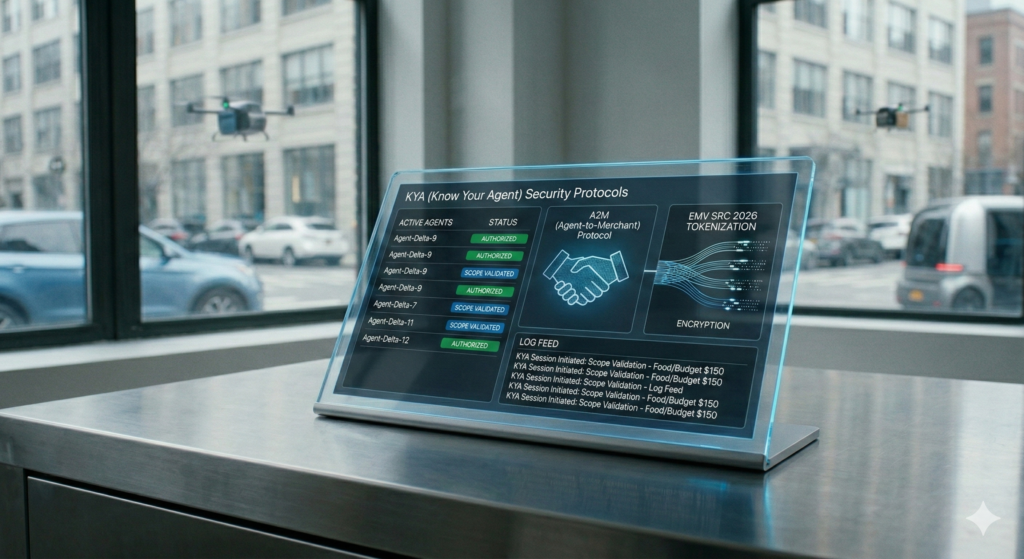
[cite_start]While traditional banking focused on “Know Your Customer” (KYC), 2026 is defined by Know Your Agent (KYA). [cite_start]This security layer ensures that every autonomous transaction is initiated by a verified, tamper-proof agent authorized by the human owner.
The KYA framework utilizes Dynamic Guardrails to monitor intent. [cite_start]By applying Behavioral Biometrics and real-time risk assessment, financial institutions can verify if an agent is operating within its pre-set scope—such as “only purchase groceries from verified eco-friendly vendors within a $150 limit”.
4. 2026 Infrastructure: The Role of AP2 and Advanced Tokenization
To support agent-led commerce, the global payment backbone has migrated to AP2 (Agentic Payment Protocol). Unlike standard APIs, AP2 allows for multi-party negotiation between the user’s agent, the merchant’s AI, and the bank’s security module.
2026 Agentic Security Stack
- [cite_start]
- 🛡️ Level 1: Hardware Isolation – Using Secure Elements to store agent keys
- 🛡️ Level 2: Dynamic Tokenization – Device-specific tokens generated per agent session
- 🛡️ Level 3: Predictive Fraud Modeling – AI analysis of agent-merchant interactions
- 🛡️ Level 4: Quantum-Resistant Encryption – Safeguarding long-term transaction data
This infrastructure ensures that Zero-Knowledge Proofs are applied to every purchase. Merchants receive valid payment confirmation and necessary fulfillment data without ever accessing the underlying financial identity or behavioral history of the human user.
5. Strategic Recommendations: Action Plan for 2026 Adoption
[cite_start]As the mobile payment landscape evolves rapidly in 2026, navigating the shift toward Agentic Adoption requires a proactive strategy for both consumers and businesses. Success in this era depends on balancing the efficiency of AI-driven transactions with robust security oversight.
2026 Strategic Implementation Roadmap
| Stakeholder | Primary Action | Priority Level |
|---|---|---|
| Consumers | Establish KYA Guardrails & Budget Caps | Critical |
| SMEs | Integrate Agent-Friendly API Endpoints | High |
| Enterprises | Deploy Multi-Platform A2M Protocols | High |
[cite_start]For businesses, a multi-platform approach has become essential to maximize customer reach and transaction volume. Meanwhile, consumers must prioritize device ecosystem alignment to ensure their AI agents can leverage seamless integration with existing financial tools.
Ultimately, the implementation timeline for these systems varies based on technical infrastructure, but the return on investment for early adopters is driven by a significant reduction in transaction friction and fraud rates—which are now approximately 80% lower than traditional card methods.
Frequently Asked Questions
Can an AI agent spend more than I intend?
No. Both platforms require strict biometric or passcode authentication to set “Hard Caps”. 2026 guardrails allow users to instantly review recent transaction history and receive alerts about any attempted unauthorized access by an agent.
How secure are agentic payments compared to traditional cards?
Agentic payments are significantly more secure due to multi-layered tokenization, biometric authentication, and real-time fraud detection. In fact, the risk of fraud is approximately 80% lower than with physical card transactions.
What is the cost of implementing agentic systems for businesses?
Implementation costs vary. Small retailers typically spend $500–$2,000 for basic setup, while large enterprises may invest $50,000–$200,000 for comprehensive integration with existing systems.
Conclusion: Navigating the Future of Finance
The mobile payment landscape in 2026 presents unprecedented opportunities for both consumers and businesses. By understanding the strengths and capabilities of agentic platforms, stakeholders can make Informed Decisions that align with their specific financial and strategic objectives.
As technology continues to evolve, staying informed about platform updates and emerging trends will be crucial for maximizing the benefits of mobile payment adoption. Trust in 2026 is built on a foundation of absolute privacy and industry-leading security standards.